書海 ApsûVoyage of a Thousand Books
選擇語言 · Choose your language
Chart of the Sea of Books
Drag or zoom the chart. Tap an island to go ashore.
Buildings on this island
A book is still hidden here. From Chapter 3, readers can sponsor it together to clear the fog.
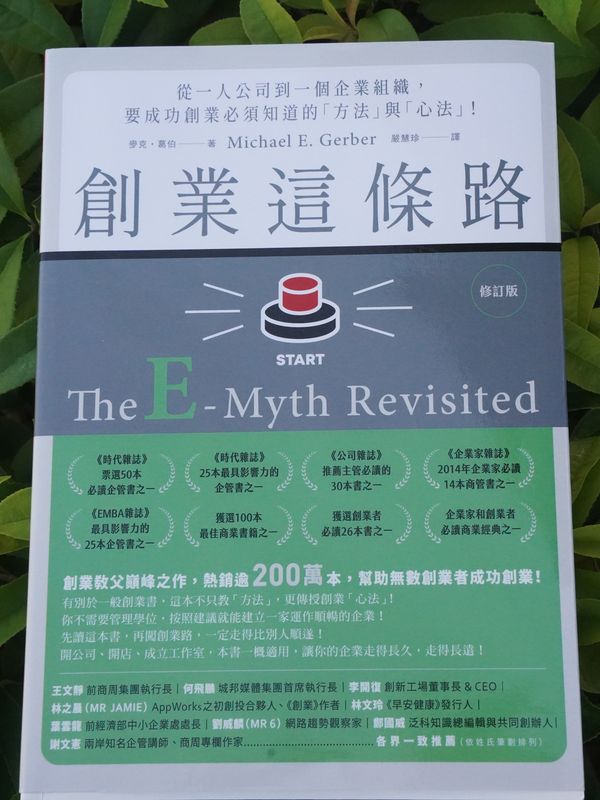
- Professionals who feel burned out or underpaid at work and just want to break out and become their own boss
- Anyone with an entrepreneurial dream
- Business owners who feel like they have to do everything themselves and are exhausted
- A well-known American business coach and author
- Named "the World's #1 Small Business Guru" by Inc. Magazine
- Founded E-Myth Worldwide (now Michael E. Gerber Companies), spending decades helping countless small business owners systemize their companies
Other Books
- The E-Myth Mastery
- Awakening the Entrepreneur Within
- The Most Successful Small Business in the World
- The E-Myth Manager
- The E-Myth Contractor
Gerber argues that most small business founders aren't really "entrepreneurs" at all. They're "technicians suffering an entrepreneurial seizure." Because they're good at a particular craft, they assume that knowing the craft is the same as knowing how to run a business, jump into starting one, and end up drowning in daily busywork.
The book says every business owner houses three competing personalities:
- The Entrepreneur: dreams, looks ahead, creates vision and strategy, and designs the business as a system that can run on its own.
- The Manager: brings planning, order and predictability; builds processes, tracks progress and keeps things stable.
- The Technician: does the hands-on work, lives in the present, likes to "do it right myself," and is often skeptical of systems and delegation.
Most small business owners are roughly "10% Entrepreneur, 20% Manager, 70% Technician." That is the root of why so many small businesses get stuck: the owner is busy doing the work, but no one is running the business.
Gerber divides a business's growth into three stages:
Infancy: the owner is the business. The owner does everything, and the business depends entirely on one person's energy and skill.
How to get out: admit you can't do it all alone. Change your mindset early: while the business is still small, stop running it with the technician's "I do it best" mentality and start practicing handing work to systems, not just to people.
Adolescence: the workload outgrows what the owner can handle alone, so the owner starts hiring help.
The common trap in adolescence is "Management by Abdication": dumping work on employees without teaching methods or setting standards, just saying "you handle it," and then jumping back in to fight fires when the results disappoint. Gerber calls this fake delegation abdication, and it is the main reason adolescent businesses stay stuck and owners end up even more exhausted.
How to get out: "Management by Delegation." Instead of dumping work, clearly define the results, standards and processes, then authorize employees to follow them and keep tracking the outcomes.
Maturity: the business now has repeatable, scalable systems and no longer depends simply on the founder's personal skills.
The McDonald's story: Ray Kroc was not a chef and had no restaurant background. He never went to college and worked as a paper-cup salesman, musician, radio host, restaurant worker and milkshake-machine salesman, among other jobs. In 1954, at 52, he heard about a hamburger stand in California that was running eight of his milkshake machines at once and could make forty shakes at a time. Curious, he went to see it and sat in his car watching the lines of customers. That was the start of his story with McDonald's.
Gerber highlights two details to show that Kroc's real talent was designing systems, not making burgers. He treated French fries with almost religious rigor, even sending people with hydrometers to test the water content of suppliers' potatoes. In the prototype store, fries could sit in the warmer for no more than seven minutes so they wouldn't go soggy, and burgers could sit off the grill for no more than ten minutes to stay moist. Every step was tested in the prototype store first, then turned into a repeatable, controllable standard procedure.
Gerber says McDonald's really sells a "system for doing business," not hamburgers. Any ordinary employee who follows the standard operating procedures can reproduce consistent results.
He argues that whether or not you ever franchise, every owner should build the business as "the prototype for a thousand future franchises." Key principles include:
- The business must deliver consistent, predictable value. Customers don't care who serves them; they care whether every experience is the same.
- Systems over individuals. Turn the know-how in the owner's and employees' heads into written procedures, manuals and checklists, so the system runs the business instead of relying on a particular person's talent or mood.
- Build an Operations Manual. Document every position and every process so anyone who takes over can follow it and deliver the same quality.
Besides McDonald's, Gerber names other brands he sees as embodying the franchise-prototype spirit: FedEx, Disney World, Mrs. Fields Cookies, Subway, Domino's Pizza, KFC, Pizza Hut, Taco Bell, UPS and Universal Studios. His point is that these companies scaled to thousands of locations while keeping consistent quality because they "first built one store into a perfect prototype, then copied the system, not the individual."
The prototype is "a model of the dream." You fully realize and test the whole dream in one store before telling a franchisee, "Let me show you how it works." He stresses: "The system runs the business. The people run the system."
That is why Kroc designed his system to keep franchisees' discretion to a minimum. Franchisees had to pass rigorous training before taking over. If headquarters has designed the business well enough, every problem has already been thought through and solved, and the franchisee only has to learn how to manage the system instead of improvising.
Gerber identifies three continuously running processes:
- Innovation — constantly looking for better ways of doing things, rather than sticking to convention.
- Quantification — measuring with numbers whether each innovation actually delivers a benefit; "if it can't be measured, it can't be managed."
- Orchestration — standardizing and locking in whatever's proven to work, removing randomness so results are consistent every time.
Gerber lays out the framework to work through, in order, when building a business system:
- Primary Aim
- Strategic Objective
- Organizational Strategy
- Management Strategy
- People Strategy
- Marketing Strategy
- Systems Strategy
1. Primary Aim
First decide what you want your life to look like. This is the starting point of the whole program. Gerber stresses that without a primary aim, you can't judge whether the business will help you reach your life goals.
2. Strategic Objective
Translate the primary aim into a concrete statement of what the business will look like when it's done (for example its revenue; the standard is money).
How big is your vision? When it's finally complete, how big will your company be? A $300,000 company? A million-dollar company? A $500 million company? If you don't know, how can you know whether your business will help you achieve your primary aim?
3. Organizational Strategy
Based on the strategic objective, draw the ideal organization chart and positions, instead of building around the abilities of the people you already have.
If everyone is doing everything, who is accountable for anything? Without an organization chart, everything depends on luck and good feelings, on people's personalities and the goodwill they share.
A sample organization chart might include these positions:
- President / Chief Operating Officer: responsible for achieving the strategic objective overall; reports to the shareholders.
- VP of Marketing: responsible for finding customers and for finding new ways to satisfy their needs at lower cost and greater convenience; reports to the COO.
- VP of Operations: responsible for keeping customers by delivering what marketing promised, and for finding new ways to produce the product at lower cost and higher efficiency so customers are served better; reports to the COO.
- VP of Finance: supports marketing and operations in fulfilling their responsibilities by meeting the company's profit standards and raising money at the best rates when needed; also reports to the COO.
- Two positions reporting to the VP of Marketing: Sales Manager and Advertising/Research Manager.
- Three positions reporting to the VP of Operations: Production Manager, Service Manager and Facilities Manager.
- Two positions reporting to the VP of Finance: Accounts Receivable Manager and Accounts Payable Manager.
Even if the business has only two people, their names should fill every box on the chart. Those two people will be both shareholders and employees.
The next step is to write a Position Contract for every position on the chart. A position contract summarizes the results the position must achieve, the work its holder is accountable for, a list of standards for evaluating the results, and a signature line for the person who agrees to fulfill these responsibilities.
4. Management Strategy
Build a management system and teach your up-and-coming managers to use it, so that anyone placed in a position on the chart produces predictable, repeatable results. This step is what makes the organization drawn in step 3 actually work.
5. People Strategy
Get the team to actually carry out the management system built in the previous step. The focus is on hiring and training people to follow the system rather than relying on their individual judgment or talent.
6. Marketing Strategy
Understand the customer's perceived needs, then build and test a prototype that satisfies them.
When you create your marketing strategy, you must forget your dreams, forget your vision, forget your interests, forget what you want. Forget everything except your customer!
A famous saying goes, "Find a need and fill it." That isn't quite right. It should say, "Find a perceived need and fill it." If your customer doesn't perceive that he needs something, he truly doesn't, even if he actually does.
These perceptions are at the heart of your customer's decision-making. If you know your customers' demographics, you can understand what those perceptions are, then work out what you must do to satisfy them and the expectations they create.
Every Demographic Model has a specific, identifiable set of perceptions. Women of a certain age, with a certain level of education, a certain family size, living in a certain region, buy for very specific psychological reasons. Those unconsciously held reasons will differ from those of another group of women of a different age, marital status and education, living in a different part of the country.
Your customers are flooded with so many products and promises that they fall into confusion and indecision. The challenge of our time is to learn your customer's language, then speak it clearly and fluently so your voice is heard above the noise.
"Specifically, who is my customer? What is their demographic profile? How do you find the people you haven't met yet?"
7. Systems Strategy
Document everything that came out of the first six steps as hard systems, soft systems and information systems, so you can actually deliver the experience you promised customers.
The soft system here means the sales system. It is a carefully choreographed interaction between you and your customer that follows six main steps:
- Identify the specific benchmarks, or customer decision points, in the sales process.
- Write the words that successfully lead you to each point as a literal script (yes, written out like a stage play!).
- Create the materials to use with each script.
- Memorize the script for each benchmark.
- Have your salespeople deliver each script in exactly the same way.
- Teach your people to communicate more effectively by speaking, seeing, listening, hearing, confirming, understanding and engaging as fully as possible with each prospect.
At E-Myth Worldwide this is called the "Power Point Selling System." A career development company they worked with handed it to people with no sales experience at all, and revenue rose 300% within a year.
The most important part of the Power Point Selling System is the Power Point Selling Process, which consists of:
- The Appointment Presentation
- The Needs Analysis Presentation
- The Solutions Presentation
Gerber asks readers to run a thought experiment: pretend the store you're running right now will be the prototype for five thousand more locations. Then ask yourself three questions:
- How do I get my business to run without me having to be there personally?
- How do I get my employees to do good work without me constantly stepping in?
- How do I systemize my business so that even after replicating it five thousand times, the five-thousandth location runs as smoothly as the first?
He also explicitly argues that the prototype store should be designed assuming it will be operated by people with the "lowest skill level" — because if the system depends on highly skilled people to run, it can't be replicated, since such people are scarce and expensive in the marketplace. This is the concrete expression of being "systems-dependent" rather than "expert-dependent."
That said, I think the book's structure could be clearer, and I'd have liked more variety in the examples — startups, software companies, and so on. Not everyone wants to build the next McDonald's.
The book was published in 2020. Fast-moving industry trends, geopolitics, and marketing methods all shape how we think about building a business. For example, how can AI be used well to build the 'systems' the author talks about? In an era of labor shortages, does the seven-step framework need updating?
Also, based on my own experience, I think the selling system the author describes would be even better with 'asking and listening' added to it.
I see this book as a reminder for entrepreneurs, not a rulebook that guarantees you'll build a business just by following it.
Message bottles

Shang, God of the Sea
His bald head catches the moonlight and shines like a lighthouse for lost voyagers.
Every book he has read became a building on this sea.
More sea gods will arrive later, bringing their own books.
Shang's books
Voyager's Guide
This world
The Sea of Books has 29 real islands, one for each subject. Every building on an island is a book.
What you can do now
- Tap an island on the chart to go ashore
- Tap a building to read the notes on that book
- Meet Shang in the Temple of the Sea
Coming soon
- Chapter 2: register as a voyager, sail your ship, collect building badges, send message bottles
- Chapter 3: shells, the harbor market, clearing the fog, rankings
- Chapter 4: private chats with other voyagers
Symbols
Temple Registry
Before you set sail, Shang will register your ship.